
CPM Calculator
CPM — cost per mille — is the price of one thousand ad impressions. Enter any two of cost, impressions and CPM to find the third, add clicks and conversions to see CTR, CPC and cost per acquisition, and use the publisher view to calculate eCPM from revenue. Handy for planning campaigns and comparing media quotes.
- Free to use
- No sign-up
- Runs in your browser
CPM calculator
Ad Campaign Planning Workbook
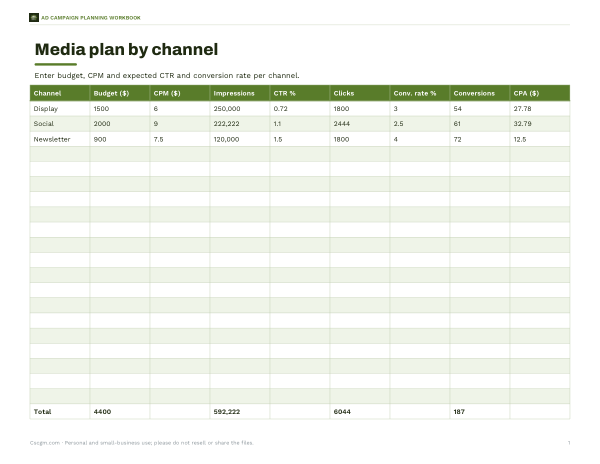
Excel media plan with CPM, CTR, CPC, CPA and ROAS by channel, a campaign brief template, an ad metrics formula card and a weekly performance log.
- Media plan (XLSX)
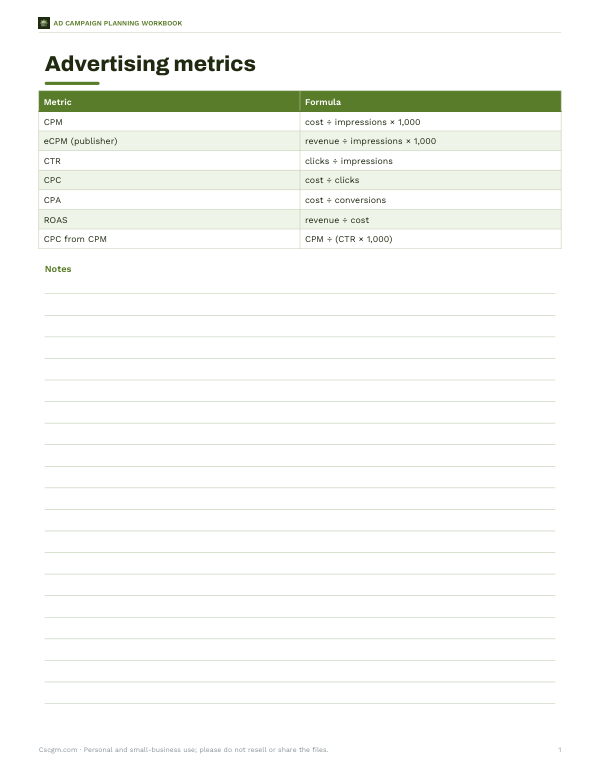
- Formula card (PDF)
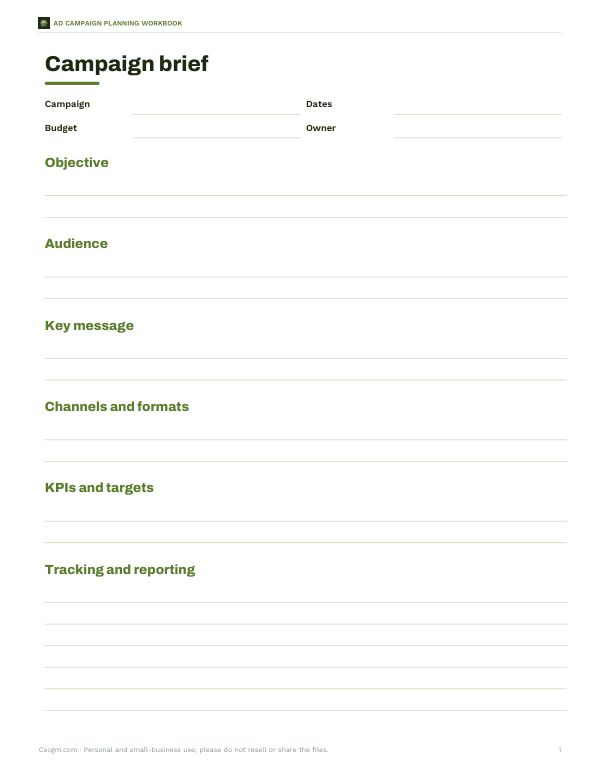
- Campaign brief (DOCX)
- Weekly log (XLSX)
Formats: XLSX, PDF, DOCX. Instant download after payment (link valid 72 hours, up to 5 downloads). AI-assisted: the templates were drafted with AI help and reviewed and laid out before publishing.
$4.00 USD, one-time 4 files · about $1.00 each
- Instant download
- 7-day refund
- Secure checkout by Stripe
7-day money-back guarantee. Full refund within 7 days of purchase, even after you download.
Free sample: Ad Metrics Formula Card (PDF, 53 KB)
Full refund within 7 days — see the refund policy and license.
Free printables
Single sheets you can print right now, no sign-up. The full pack adds every sheet in one download plus the editable files.
 Printable Weekly CPM Log
What CPM means
CPM stands for cost per mille — “mille” is Latin for thousand — and is the price an advertiser pays for one thousand impressions (views) of an ad. It is the standard pricing unit for display, video, social, podcast and print advertising where the goal is reach and awareness. CPM = total cost ÷ impressions × 1,000. If a campaign costs $1,500 and delivers 250,000 impressions, the CPM is $1,500 ÷ 250,000 × 1,000 = $6.00.
Solving for budget or impressions
| You know | You want | Formula |
|---|---|---|
| Cost and impressions | CPM | cost ÷ impressions × 1,000 |
| CPM and impressions | Budget | CPM × impressions ÷ 1,000 |
| CPM and budget | Impressions | budget ÷ CPM × 1,000 |
Example: to reach 400,000 impressions at a quoted CPM of $8.50, the budget is 8.50 × 400,000 ÷ 1,000 = $3,400.
CPM, CPC, CPA and CPV
| Model | You pay for | Suits |
|---|---|---|
| CPM | Every 1,000 impressions | Brand awareness, reach |
| CPC | Each click | Traffic to a website |
| CPA / CPL | Each action or lead | Sales and sign-ups |
| CPV | Each video view (definition varies by platform) | Video campaigns |
Converting between them helps compare offers: effective CPC = CPM ÷ (CTR × 1,000). A $6 CPM with a 0.72% CTR works out at about $0.83 per click.
eCPM for publishers
Publishers use eCPM (effective CPM) to compare how much different ad sources earn: eCPM = revenue ÷ impressions × 1,000. If a website earns $540 from 180,000 ad impressions, its eCPM is $3.00. RPM (revenue per mille) is similar but is often calculated per page view rather than per ad impression. Tracking eCPM by page type, device and country shows where monetisation is strongest.
What affects CPM
- Audience targeting — narrower, higher-value audiences cost more per thousand.
- Platform and placement — premium sites, connected TV and in-feed video usually cost more than standard display banners.
- Seasonality and competition — CPMs tend to rise when many advertisers compete for the same audience, such as late in the year.
- Ad format — video and rich media cost more than static images.
- Geography — impressions in some countries cost much more than in others.
- Viewability — some buys charge only for viewable impressions (vCPM).
Worked example: comparing two offers
A small brand is offered two options: a newsletter sponsorship at $900 for 120,000 email opens, and a display campaign at a $5.50 CPM. The newsletter works out to a CPM of $7.50 — more expensive per thousand, but if its audience clicks at 1.5% against 0.3% for display, its effective CPC is $0.50 versus about $1.83 for display. CPM is the starting point; clicks and conversions complete the comparison.
Reading the extra metrics
CTR (click-through rate) = clicks ÷ impressions. CPC = cost ÷ clicks. CPA = cost ÷ conversions. ROAS (return on ad spend) = revenue ÷ cost; a ROAS of 2.8× means $2.80 of revenue for each $1 spent. Remember that revenue is not profit — account for product costs and margins when judging whether a campaign pays.
Common mistakes
- Forgetting the × 1,000 — CPM is per thousand, not per impression.
- Comparing CPMs from platforms that count impressions differently.
- Judging awareness campaigns only by clicks.
- Ignoring frequency — the same person seeing an ad many times inflates impressions.
- Comparing a CPM quote with a CPC quote without converting.
Planning a campaign budget
- Decide the goal — awareness, traffic or sales — and the audience.
- Estimate how many people you want to reach and how often (frequency).
- Impressions needed = reach × frequency. Reaching 50,000 people three times is 150,000 impressions.
- Budget = impressions × expected CPM ÷ 1,000. At a $7 CPM, 150,000 impressions cost $1,050.
- Estimate clicks and conversions from expected CTR and conversion rate to see the likely CPA.
- Compare the CPA with the profit per sale to judge whether the campaign can pay back.
Reach, frequency and impressions
Impressions count every time an ad is shown, so one person who sees an ad five times generates five impressions. Reach counts unique people. Frequency is impressions divided by reach. For awareness campaigns, a moderate frequency helps people remember the message, but very high frequency wastes budget and can annoy the audience. Most ad platforms report reach and frequency alongside impressions and let you cap how often the same person sees an ad.
CPM in traditional media
CPM began in print and broadcast, where it lets buyers compare media with very different prices. A magazine page costing $12,000 with 400,000 readers has a CPM of $30; a radio spot costing $250 heard by 50,000 listeners has a CPM of $5. Audience figures in traditional media are estimates from circulation audits and surveys rather than counted impressions, so comparisons with digital CPMs should be made with care.
Privacy
The calculator runs in your browser; campaign figures are not stored or sent anywhere.
Frequently asked questions
How do you calculate CPM?
Divide total cost by impressions and multiply by 1,000.
What does CPM stand for?
Cost per mille — cost per thousand impressions.
What is a good CPM?
It varies widely by platform, audience, format and country; compare within similar campaigns.
How do I convert CPM to CPC?
CPC = CPM ÷ (CTR × 1,000), with CTR as a decimal.
What is eCPM?
Effective CPM for publishers: revenue ÷ impressions × 1,000.
Why is my CPM rising?
Common causes are more competition for the same audience, narrower targeting, seasonal demand, lower ad relevance or engagement, and higher-cost placements such as video.
Is a lower CPM always better?
No. A cheap CPM with poor clicks or conversions can cost more per result than a higher CPM that reaches the right people.
Is my data stored?
No, it runs in your browser.